Multigrid solvers
For queries about this topic, contact Chris-Kriton Skylaris.
View the calendar of events relating to this topic.
Projects
Can we calculate the pKa of new drugs, based on their structure alone?
Chris-Kriton Skylaris (Investigator), Chris Pittock, Jacek Dziedzic
The pKa of an active compound in a pharmaceutical drug affects how it is absorbed and distributed around the human body. While there are various computational methods to predict pKa using only molecular structure data, these tend to be specialised to only one class of drug - we aim to generate a more generalised prediction method using quantum mechanics.
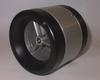
Complexity in Modelling Electric Marine Propulsive Devices
Suleiman Sharkh, Neil Bressloff, Hans Fangohr (Investigators), Aleksander Dubas
This project involves the simulation of turbulent flow around a marine rim-driven thruster and the complex interaction of flow features involved through computational fluid dynamics. Following this, the optimisation of design parameters using computational fluid dynamics to calculate the objective function is performed and surrogate modelling utilised to estimate optimum design configuration.
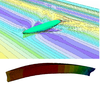
Coupled Fluid-Structure Interaction to model Three-Dimensional Dynamic Behaviour of Ships in Waves
Pandeli Temarel, Zhi-Min Chen (Investigators), Puram Lakshmynarayanana
In the present study we focus our attention on fluid-structure interactions (FSI) of flexible marine structures in waves by coupling a fluid solver using Computational Fluid Dynamics (CFD) and a structural solver using Finite Element Analysis (FEA) software.
Development of wide-ranging functionality in ONETEP
Chris-Kriton Skylaris (Investigator), Jacek Dziedzic
ONETEP is at the cutting edge of developments in first principles calculations. However, while the fundamental difficulties of performing accurate first-principles calculations with linear-scaling cost have been solved, only a small core of functionality is currently available in ONETEP which prevents its wide application. In this collaborative project between three Universities, the original developers of ONETEP will lead an ambitious workplan whereby the functionality of the code will be rapidly and significantly enriched.
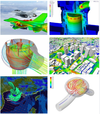
Massively-Parallel Computational Fluid Dynamics
Simon Cox, Stephen Turnock, Alexander Phillips (Investigators), James Hawkes
Computational Fluid Dynamics (CFD) is a numerical method for modelling fluid flows and heat transfer - and is used in many industries. It can be used to model dynamics around aircraft, ships and land vehicles; and also has uses in engine design, architecture, weather forecasting, medicine, computer-generated imagery (CGI) and much more. To harness the full power of CFD, it is necessary to utilise the full power of modern supercomputers. This project aims to improve the scalabilty of existing CFD codes so that more complex problems can be tackled efficiently.
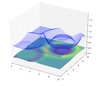
Multiscale modelling of neutron star oceans
Ian Hawke (Investigator), Alice Harpole
Type I X-ray bursts are explosions which occur on the surface of some
neutron stars. It is believed that the burning begins in a localised spot in the ocean of the
star before spreading across the entire surface. By gaining a better understanding of X-ray
bursts, it is hoped that tighter limits can be determined for other neutron star properties
such as the radius and magnetic field strength.
Prediction of orifice flow flooding rates through generic orifices
Dominic Hudson, Ming-yi Tan (Investigators), Christian Wood, Adam Sobey
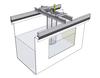
This presearch concentrates on the modelling of compartment flooding rates following the occurrence of damage in a ship's side shell. Typical state of the art flooding models use Torricelli’s formula to calculate flooding rates using a constant co-efficient of discharge (Cd). Based on Bernoulli’s theorem, turbulence and viscosity effects are not included using a Cd independent of damage shape or size. Previous work indicates that this assumption over-simplifies the problem to an extent where the flooding rates used for calculation are in error. This project will use CFD validated by experiment to calculate flooding rates for a large number of cases from which a 'krigged' response surface will be generated. Validity of the subsequent response surface will be interrogated.
People
 Neil Bressloff
Professor, Engineering Sciences (FEE)
 Simon Cox
Professor, Engineering Sciences (FEE)
 Hans Fangohr
Professor, Engineering Sciences (FEE)
 Suleiman Sharkh
Professor, Engineering Sciences (FEE)
 Pandeli Temarel
Professor, Civil Engineering & the Environment (FEE)
 Stephen Turnock
Professor, Engineering Sciences (FEE)
Nicolas GreenReader, Electronics and Computer Science (FPAS)
Tobias KellerReader, Ocean & Earth Science (FNES)
 Dominic Hudson
Senior Lecturer, Engineering Sciences (FEE)
 Edward Richardson
Senior Lecturer, Engineering Sciences (FEE)
Zhi-Min ChenLecturer, Chemistry (FNES)
 Ian Hawke
Lecturer, Mathematics (FSHS)
 Chris-Kriton Skylaris
Lecturer, Chemistry (FNES)
 Ming-yi Tan
Lecturer, Engineering Sciences (FEE)
Felipe Alves PortelaResearch Fellow, Engineering Sciences (FEE)
Petros BogiatzisResearch Fellow, Ocean & Earth Science (FNES)
 Aleksander Dubas
Research Fellow, Engineering Sciences (FEE)
 Jacek Dziedzic
Research Fellow, Chemistry (FNES)
 James Hawkes
Postgraduate Research Student, Engineering Sciences (FEE)
Puram LakshmynarayananaPostgraduate Research Student, Civil Engineering & the Environment (FEE)
 David Lusher
Postgraduate Research Student, Engineering Sciences (FEE)
 Juraj Mihalik
Postgraduate Research Student, Engineering Sciences (FEE)
 Lyuboslav Petrov
Postgraduate Research Student, Electronics and Computer Science (FPAS)
 Chris Pittock
Postgraduate Research Student, Chemistry (FNES)
Adam SobeyPostgraduate Research Student, Engineering Sciences (FEE)
Koen van MierloPostgraduate Research Student, Engineering Sciences (FEE)
 Petrina Butler
Administrative Staff, Research and Innovation Services
 Christian Wood
Alumnus, Engineering Sciences (FEE)
Alexander PhillipsNone, None