The MicroMOT is our initial research goal as it will be a reduction on both volume and weight of nearly 10,000 times that of typical MOTs. The internal chamber volume is sub-millilitre, hence the term 'micro' . It incorporates a grating MOT which we collaborated with the University of Strathclyde to design, a non-evaporable getter film, a source of rubidium vapour, and a gold film in which acts as a pump for excess rubidium. The bottom reflective layer is eutectically bonded to the silicon chamber and them encapsulated by anodically bonded AR-coated glass. It is encapsulated with our own 'home-built' UHV bonder. Theoretical calculations show that this cell could maintain 10-10 mbar for ten years.
Future chips will include electrical feedthroughs, active vapour control, and micro-optics. We are also developing cells for strontium atomic clocks and ion-chip quantum computers.
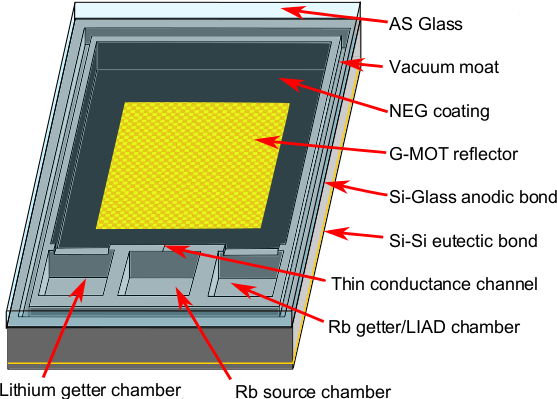
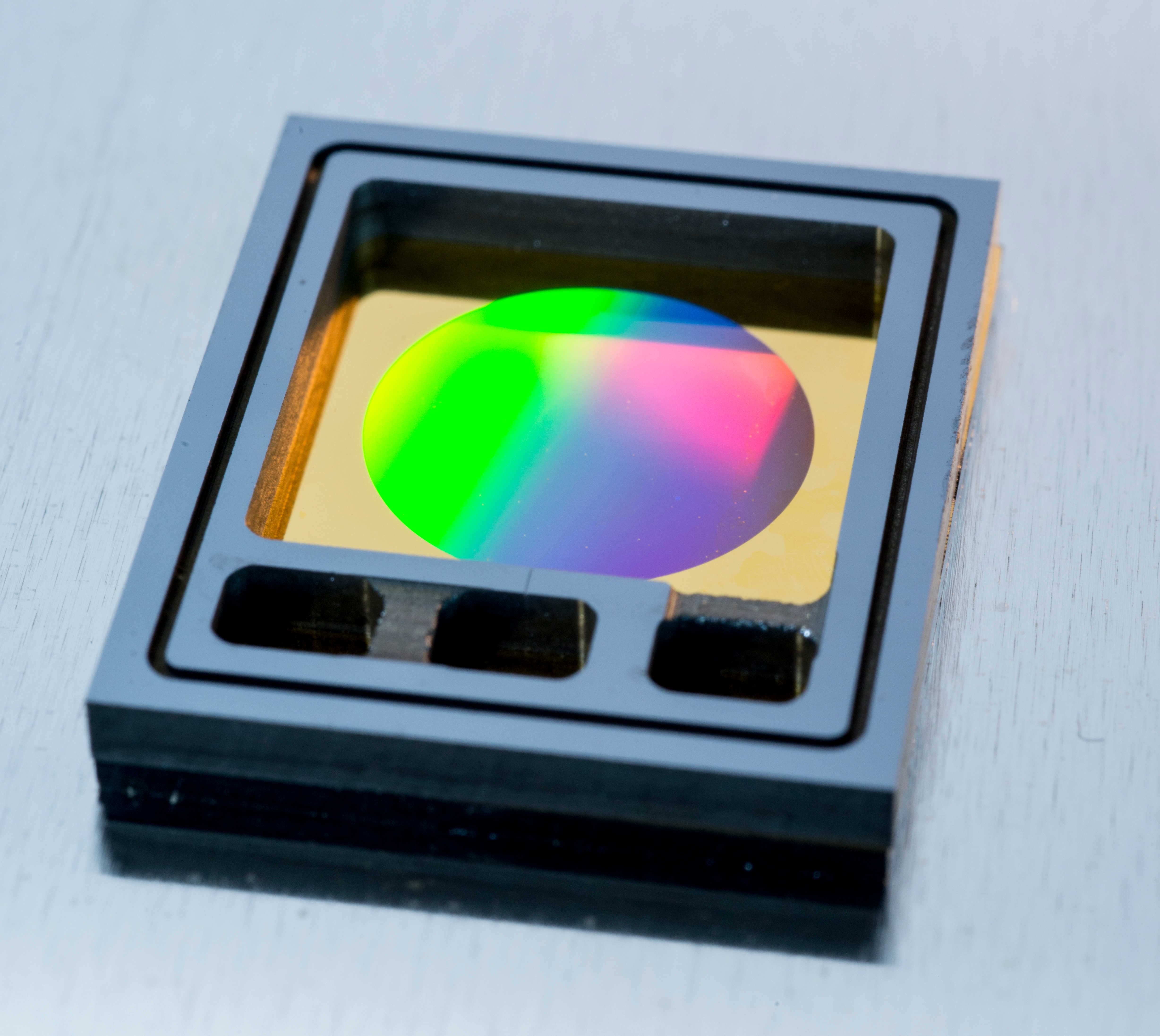
To the left is a conceptual drawing of the microMOT whilst on the right is an photograph of one of the cells under development before it is encapsulated by glass.